
Learn how email warming can prevent spam, improve deliverability, and increase your open rate.
Email remains a fundamental tool for communication and digital marketing, but the growing volume of messages and the increase in spam make achieving good deliverability difficult. be quite a challenge. By 2025, it is estimated that more than 376 billion emails will be sent and received every day, and almost half of them will be spam, according to debounce.io . In this context, email warming is presented as a technical key to prevent your messages from ending up in the spam folder and to protect your domain’s reputation.
Email Warm-Up Basics
What is email warm-up and why is it important?
Email warming is a gradual and controlled process of sending emails from a new or rarely used domain or address, with the goal of building a positive reputation with email providers. When a domain suddenly starts sending a lot of emails, spam filters often become suspicious and mark those messages as spam. Therefore, gradually increasing the volume of emails allows you to demonstrate that the sender is trustworthy and that their emails are legitimate.

This practice is essential because, according to snov.io , about 46% of emails sent end up in the spam folder. Warming up helps improve deliverability and prevent your email marketing campaigns from losing effectiveness from the first send.
How email providers' anti-spam filters work
Email providers like Gmail, Outlook, and Yahoo use complex filters that analyze multiple factors to determine whether an email is spam. These include the Domain and IP reputation, authentication using protocols such as SPF, DKIM and DMARC, message content and user behavior (e.g., whether they mark emails as spam or open them).
Additionally, filters evaluate sending patterns. A domain that sends thousands of emails at once with no prior history may be blocked or sent directly to spam. Therefore, warming up is an essential step for providers to trust that your emails are not malicious or invasive.
It’s important to note that the warm-up process isn’t just limited to increasing the volume of shipments, it also involves the quality of the content. Emails should be relevant and engaging to recipients, which can influence the open rate and in user interaction. This not only builds a good reputation, but also fosters a positive relationship with subscribers, which can translate into increased loyalty and conversion in the long run.
Furthermore, email warming can be seen as an investment in your digital marketing strategy. of a company. By dedicating time and resources to this process, you ensure that future email marketing campaigns are more effective and reach users’ inboxes. This is especially crucial in an environment where the Competition for consumer attention is fierce, and each email account is trying to maintain interest and connection with the target audience.
Effective Strategies for Domain Warming
Gradual process of increasing shipment volume
The key to warming up is patience and planning. Start by sending a small number of emails to recipients who are likely to engage with your messages, such as current customers or confirmed contacts. Then, increase the volume of shipments little by little, week after week.

This growth must be constant and controlled to avoid spikes that could raise suspicions. For example, if you start with 50 emails on the first day, you could increase to 100 the next week, then 200, and so on. This technique allows email providers to observe natural and reliable behavior.
A good warm-up also involves ensuring the quality of your recipient lists, avoiding sending emails to inactive or suspicious addresses, as bounces and complaints negatively affect your reputation.
Tactics to improve sender reputation
The reputation of the sender depends on several factors. It’s essential to always use the same domain, properly configured with SPF, DKIM, and DMARC protocols, to authenticate your emails and prevent them from being forged. Frequently changing domains, IP addresses or sender generates distrust and can harm deliverability, as recommended hugocalixto.es .
Additionally, avoiding words and formats that often trigger spam filters is vital. Terms like “FREE,” “CLICK HERE,” or “EASY MONEY,” as well as text in all capital letters, bright colors, or multiple fonts, increase the likelihood that your emails will be flagged as spam.
Another effective tactic is to maintain consistency in design and content, and encourage positive interactions with recipients, such as opens and clicks, which improve filter perception.
Process Implementation and Monitoring
Tools and platforms for email warm-up.
There are several tools that facilitate the warm-up process, automating the gradual increase in shipment volume and offering detailed deliverability reports. Email marketing platforms like Mailchimp, Sendinblue, or ActiveCampaign allow you to set up segmented campaigns and monitor key metrics.
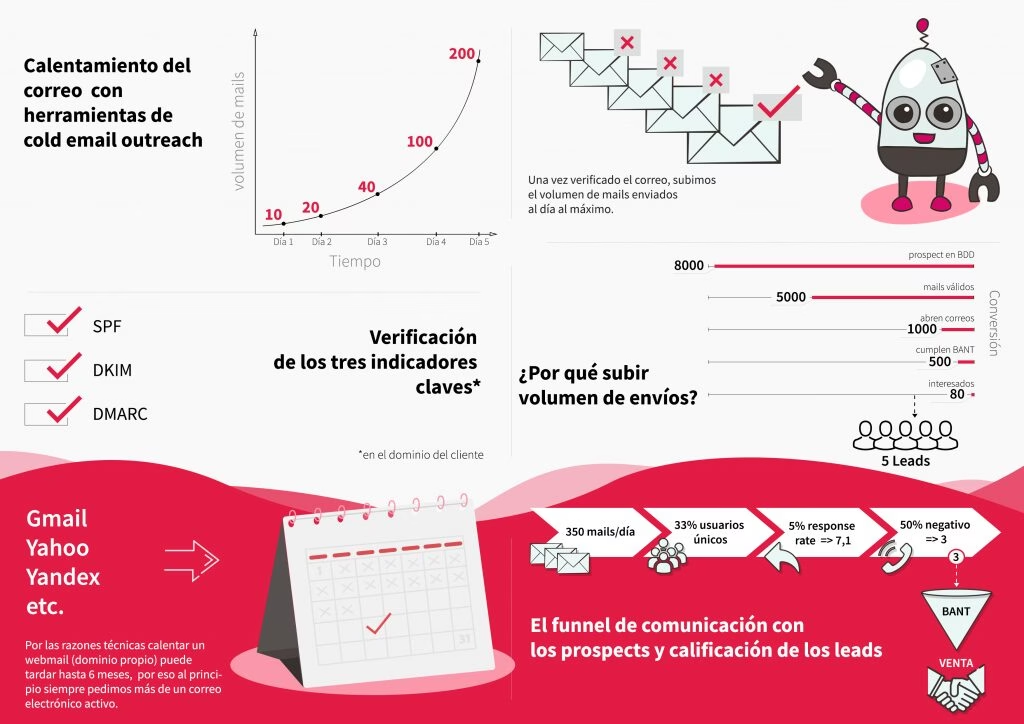
Additionally, some specialized solutions offer specific email warm-up services, managing test contact lists and simulating interactions to improve domain reputation. These tools are very useful for those starting out with a new domain or looking to restore the deliverability of a penalized domain.
Key metrics to evaluate the success of your warm-up.
To know if the warm-up is working, it is essential to monitor certain metrics. The delivery rate indicates what percentage of emails arrive in the inbox or spam folder. A good delivery rate should be high and improve over time.
It’s also important to look at the open rate and click-through rate, which reflect recipient interest and engagement. On the other hand, the bounce rate and the number of spam complaints must be kept low to avoid damaging the reputation.
According to a Kaspersky study , employees can waste up to 11 hours a year just checking spam emails, demonstrating the importance of preventing your messages from becoming part of that problem and instead ensuring they reach their destination correctly.

