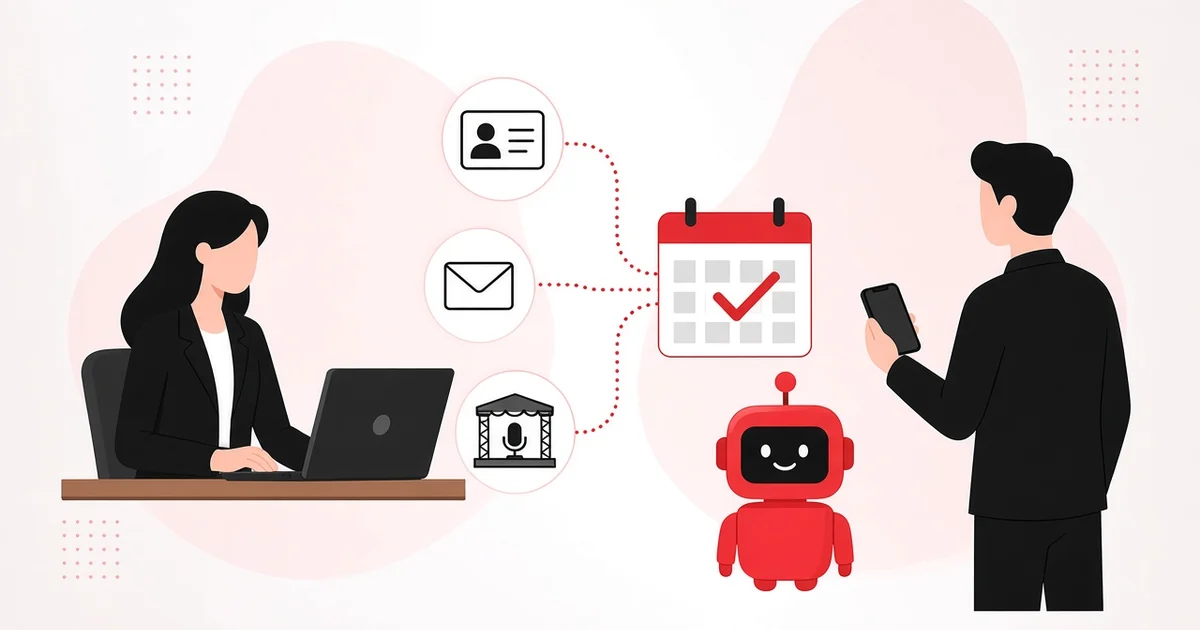
Short answer: B2B outbound prospecting works best when LinkedIn, email and events are coordinated on the same account list. LinkedIn makes the decision-maker recognise you, email explains why you are writing and events speed up the conversation. About three weeks with 6–8 useful touches is usually enough to measure interest.
Updated: November 2026 · Author: Ricard Vidal Batiste
Why combine channels in outbound?
Each channel reaches the same person in a different way. A decision-maker may ignore an email from someone they do not know and yet reply if they have already seen that name on LinkedIn or said hello at a trade fair. Combining does not mean sending more; it means each touch brings something different.
| Channel | What it is for | Strength | Limit |
|---|---|---|---|
| Recognition, context, short messages | You see job title, activity and mutual connections | Invitation and message limits; long messages are not read | |
| Cold email | Explaining the reason in detail | Scalable and measurable | Deliverability and regulation (LSSI) |
| Phone | Direct conversation | Resolves doubts on the spot | Hard to reach the decision-maker |
| Events | Face-to-face conversation | Fast trust | Cost and time; few accounts |
How do you prepare the ground on LinkedIn?
On LinkedIn you prepare the ground with a clear profile, an account-based list and short messages.
Profile. The headline should say who you help and with what, not your job title. The «About» section explains the problem you solve and links to a useful resource. To go deeper, see how to use LinkedIn to generate qualified leads.
List. Work accounts, not isolated people: 2–3 contacts per company (decision-maker, user, influencer).
Invitation. No note, or a one-line note with a real reason: a post of theirs, a shared event, a change at their company.
First message after they accept. Short, with no link and with an easy question to answer:
«Thanks for connecting, [Name]. I saw that [company] is opening [market/team]. Are you doing it with your own team or with outside support?»
Content. Posting once or twice a week about your ICP’s problems makes your messages read differently. More in outbound 3.0: connecting with leaders via LinkedIn.
How do you write a cold email that gets read?
A cold email gets read when it shows research, names a real problem and ends with a question.
Infrastructure. Use secondary domains for prospecting, warm up the mailboxes and keep volumes moderate. If your main domain lands in spam, it affects all your email.
Structure of a good first email:
1. One line that shows you have researched the account.
2. The problem a company like theirs usually has.
3. What you change, explained through what you concretely do, not with adjectives.
4. A question, not a calendar link.
Subject: [company] and [problem]
«Hi [Name]: I saw that [signal]. [Sector] companies with small sales teams often have [problem]. We [what we do] to [result]. Does it make sense for me to tell you how in 15 minutes?»
Follow-up. Each follow-up adds something: a fact, a resource, a different question. See B2B cold email sequence and following up leads without being annoying.
Legality. In Spain, commercial communications by email are regulated by article 21 of the LSSI. Review the legal basis with your adviser, always identify the sender and offer a simple way to unsubscribe.
How do you use events to speed up trust?
Events speed up trust if you prepare the conversations beforehand and follow them up afterwards.
Before. Get the list of exhibitors or attendees, cross it with your ICP and write to priority accounts 1–2 weeks before, suggesting a coffee at the event.
During. A realistic goal: a few good conversations, not lots of business cards. Note in the CRM the same day what they told you.
After. Follow up within 48 hours on LinkedIn and by email, referring to the conversation. More ideas in hybrid B2B networking.
What does a 21-day multichannel sequence look like?
A 21-day multichannel sequence alternates LinkedIn, email and phone with a new reason at each touch.
| Day | Channel | Action |
|---|---|---|
| 1 | View profile + invitation | |
| 2 | Email 1 (research + question) | |
| 4 | Reaction or useful comment on a post of theirs | |
| 6 | Email 2 (relevant resource or fact) | |
| 8 | Phone | Short call; if no answer, no long voicemail |
| 10 | Message if they accepted the invitation | |
| 14 | Email 3 (case or different angle) | |
| 21 | Friendly close: «shall I leave it here?» |
Adjust the order to your ICP: technical profiles usually respond better by email; sales profiles, by LinkedIn and phone.
Which metrics matter?
The metrics that matter in outbound are the ones that lead to meetings, not opens.
- LinkedIn invitation acceptance rate.
- Response rate and positive response rate by channel.
- Meetings booked per 100 accounts worked.
- Meetings held and accepted by sales.
To know which figures are reasonable, see response rate in B2B outbound campaigns. Your best benchmark is your own history: compare each channel and segment against its results in previous months.
How do you choose the accounts and contacts you will work?
Choosing the right accounts and contacts weighs more on the result than any message template. Start with the account and then move down to the people:
- Start from your best customers. Look for what they have in common: sector, size, country, company stage and the tools they use.
- Define timing signals. Hiring in the area you care about, market openings, funding rounds, leadership changes or presence at a trade fair.
- Prioritise on three levels. Accounts with fit and a signal (first), accounts with fit and no signal (next) and doubtful accounts (out of the first batch).
- Choose 2–3 contacts per account: whoever decides, whoever would use your solution and whoever influences the decision.
- Exclude before launching: current customers, competitors, accounts in negotiation and people who asked not to receive messages.
If you want to go deeper into how to validate this profile with campaign data, we explain it in validating the ICP with outbound.
What should you do when someone replies?
When someone replies, speed and tone matter as much as the initial message. Each type of reply calls for a different action:
| Reply | What to do |
|---|---|
| «I’m interested» | Suggest two specific time slots and confirm by email with a summary of what the meeting is for |
| «Not now» | Ask when it makes sense to talk again and note it in the CRM with a date |
| «I’m not the right person» | Kindly ask who is and mention who referred you |
| «We already have a provider» | Thank them and ask what they value about them; sometimes it opens a future conversation |
| «Don’t write to me again» | Remove the contact from every channel that same day |
| Technical question | Answer in detail or suggest your salesperson answers it on a call |
Always reply on the same channel they wrote on, at least in the first message. If someone answers on LinkedIn, do not jump to email without telling them. And log the reply in the CRM right away: that is what lets you pause the rest of the sequence and lets your salesperson arrive at the meeting with context.
Negative replies are useful information too. If many people in the same segment say «not now» or «we already have a provider», the problem may not be the message but the segment or the timing chosen.
How do you coordinate the three channels in the CRM?
Coordinating LinkedIn, email and events requires all three channels to write to the same CRM and the same account. If each channel lives in a different tool, you will end up sending someone a generic email the day after you spoke with them at a trade fair.
Four simple rules prevent it:
- One record per account, with the 2–3 contacts you work there. Every touch, on any channel, is logged on that record.
- One status per contact: not contacted, in sequence, replied, meeting, discarded. That way nobody writes again to someone who already said no.
- A pause rule: when a contact replies on any channel, the automatic sequence stops on all the others.
- One owner per account, even if several people handle different channels.
With these four rules, the CRM stops being an archive and becomes the tool that decides who receives which message and when. It also lets you measure each channel with the same criteria.
How do you adapt the sequence to job title and sector?
The 21-day sequence is a starting point; the order and tone change depending on your ideal customer’s job title and sector.
| Profile | Channel that usually opens | What the message brings |
|---|---|---|
| General management at an SME | LinkedIn or phone | Business impact, in a few words |
| Sales management | LinkedIn and phone | Pipeline, meetings and the team’s time |
| Technical profiles | Detail, context and how it fits with what they already use | |
| Marketing | Email and LinkedIn | Coordination with campaigns and content |
Test it on your own data: launch the same sequence in two different orders on similar segments and keep the one that generates more meetings accepted by your salesperson.
What are the most common mistakes?
The most common mistakes in multichannel outbound come from treating the channels separately.
- Sending the same text on LinkedIn and by email.
- Selling in the invitation note.
- Sequences of 10+ emails that add nothing new.
- Prospecting isolated people instead of accounts.
- Not logging in the CRM what happens at events.
- Measuring only opens instead of replies and meetings.
Do it in-house or with an external team?
If you have neither the time nor anyone to coordinate the three channels, an outsourced SDR can set up the sequence and deliver meetings to you. At HelloMrLead we do it like this: we develop the whole prospecting strategy, build the databases and set up the CRM and the tools; on top of that, we assign a dedicated SDR and an account manager who holds a weekly meeting with you to show the main indicators of your campaign. Tell us about your case.
Frequently asked questions
What is outbound prospecting on LinkedIn?
It means proactively contacting decision-makers who match your ideal customer profile through invitations, messages and content on LinkedIn, usually combined with email and phone.
Is LinkedIn or cold email better?
They do not compete: LinkedIn builds recognition and email lets you explain in detail. Coordinated on the same account list they perform better than separately, because each channel brings something different to the same decision-maker.
How many messages should a sequence have?
About 6–8 useful touches over roughly three weeks, spread across channels, are usually enough to know whether there is interest. More touches that add nothing new wear down your brand.
Should I add a note to a LinkedIn invitation?
Only if you have a real, specific reason. A sales note lowers acceptance; a reference to a post of theirs, a shared event or a change at their company works better.
How do I avoid writing to someone who already replied on another channel?
Log every touch on the same account record in the CRM and pause the automatic sequence on all channels as soon as the contact replies on any of them. That way nobody gets a generic email after having spoken with you.
How do I use an event to prospect?
Write to priority accounts beforehand, aim for a few quality conversations and follow up within 48 hours, referring to what you talked about. Note each conversation in the CRM the same day.
About the author. Ricard Vidal Batiste is the founder of HelloMrLead. He leads the agency’s outbound prospecting strategy and the work of its SDRs with B2B companies in Spain.

