
Learn how to create a B2B sales funnel that converts from the first contact, optimizing each stage to increase your closing rates and boost your business growth.
Did you know that 44% of salespeople give up after just one follow-up attempt? ? This statistic reveals a major common mistake in B2B sales: giving up too soon. In an environment where 80% of sales require at least five follow-up calls, designing a sales funnel that maintains interest and converts from the first contact is key to commercial success. This explains how to build a solid and effective process that responds to the real needs of B2B buyers.
Fundamentals of a B2B Cash Funnel
A B2B sales funnel is not just a series of steps to close a sale; it is a strategic path that accompanies the customer from the first contact to the final decision. Effective prospecting is fundamental: in fact, 64% of commercial success in B2B is attributed to this initial stage. Without proper identification and outreach to the right prospects, the rest of the process loses its effectiveness.

In addition, B2B buyers expect companies to understand their unique needs and interests. According to Salesforce, 73% of them value being offered a personalized and relevant experience. This means that the funnel must be designed to capture and respond to these expectations from the beginning, avoiding generic messages that don’t connect.
To delve deeper into these figures and their impact, you can consult Salesforce’s detailed analysis of B2B buyer expectations .
Key differences between B2B and B2C funnels
In the B2B world, purchasing decisions are usually more complex, involving several stakeholders and longer cycles. Unlike B2C, where purchasing can be impulsive, in B2B the process is meticulous and requires multiple steps. points of contact . Therefore, a B2B funnel must include stages that allow building trust and demonstrating value over time.
Another important difference is the type of content that works best. While B2C is dominated by emotional and fast-paced messages, B2B content should be educational, detailed, and geared towards solving specific business problems.
Identification and segmentation of the ideal B2B customer
For the funnel to work, it is essential to accurately define who the ideal customer is. This involves segmenting according to variables such as industry, company size, role within the organization, and specific needs. This segmentation allows for personalized messages and offers, increasing relevance and conversion rate .
Knowing the ideal customer in depth also helps to prioritize prospecting efforts, avoiding wasting time on unqualified leads. In addition, it facilitates the creation of profiles that guide content generation and parenting strategy.
Strategic design of the funnel stages.
A well-designed B2B funnel should consider all phases of the buyer’s journey: from awareness to decision and loyalty. Each stage requires a different approach and tailored content to move the prospect towards a purchase.
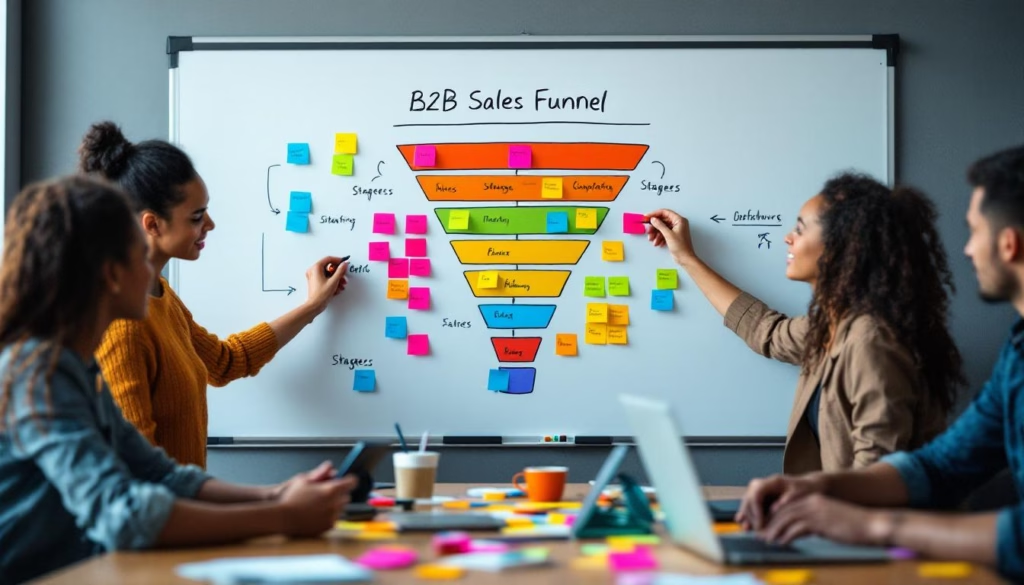
Implementing appropriate touchpoints is crucial. A single email or call is not enough; 60% of customers say “no” at least four times before accepting a proposal. Therefore, automated nurturing becomes an ally to maintain interest without overwhelming the prospect.
To better understand how to structure these stages and automate the process, Sales Business School offers a practical approach to effective prospecting .
Creating valuable content for each stage of the buyer's journey.
Content is the engine that drives the funnel. In the knowledge phase, it is advisable to offer educational materials such as e-books, webinars, or blogs that help identify problems and possible solutions. The proposal should include success stories, comparisons, and demonstrations that prove its value.
Finally, in the decision, the content should foster trust and eliminate doubts, with testimonials, guarantees, and clear details about the implementation. 83% of B2B buyers prefer to learn through digital content rather than salespeople, so investing in a solid content strategy is essential.
More on this trend can be found in the Content Marketing Institute report .
Implementation of automated touchpoints and rearing
Constant monitoring is vital. Since 80% of sales require at least five follow-up calls, automating this process with CRM and email marketing tools allows you to maintain communication without losing efficiency.
Automated care helps send personalized messages at the right time, based on the prospect’s behavior and interests. This increases the likelihood of conversion and reduces the manual workload for the sales team.
B2B funnel optimization and measurement
Measuring funnel performance is the only way to ensure it works and identify areas for improvement. To achieve this, it is necessary to define clear KPIs for each stage, starting with the open rate of emails until the final conversion.

Furthermore, collaboration between teams is essential. However, only 50% of B2B marketing specialists consider sharing data with other departments to be easy. Breaking down these silos improves visibility and data-driven decision-making.
Artificial intelligence also plays an important role, saving more than two hours on manual tasks and allowing for deeper and faster data analysis.
To delve deeper into these advantages, Cepymenews offers updated statistics on the impact of AI in B2B marketing .
Essential KPIs to evaluate the effectiveness of each stage
Some key KPIs include the conversion rate per stage, the average time a prospect spends in each stage, the percentage of qualified leads, and the return on investment in content campaigns. Monitoring these indicators allows for adjusting the strategy and optimizing resources.
For example, if the conversion rate in the consideration stage is low, it may be a sign that the content is not answering the prospect’s questions or that the touchpoints are not sufficient.
Testing strategies and continuous improvement of the conversion process.
The funnel is not static. You should constantly test different messages, formats, and channels to identify what works best. A/B testing is a valuable tool for experimenting with emails, landing pages, and calls to action.
In addition, collecting direct feedback from customers and analyzing their behavior allows the funnel to be adapted to their real needs. Continuous improvement is the key to maintaining a B2B sales process that converts from the first contact.

